
I've been recording Six Feet Under on my DVR lately. After a few years of friends suggesting that "you'd really love this show," I finally have the impetus to watch--and boy am I glad. Tonight I just finished watching what I think is the first episode of season 3, where Nate has multiple visions of possible lives while under aneaesthesia. I thought his (what I assume is the first) vision, being married to what's her name--Lisa? Enamored with fatherhood, was beautiful and reminicent of life on this homefront. There were also plenty of quirky little Los Angeles things that I thought were fun, like Lisa's annoyingly self-absorbed boss "in the business." I would just say, I think every person in the ministry should watch this metaphysical comedy drama mystical treatise on life and death and the hereafter. Good schtufff.
On the subject, I rode with the local funeral home director on a 20 minute drive out to the country cemetary where we buried Jerry today. As we pulled in to the cemetary, after a long conversation about the culture of grief in Oklahoma (which perhaps I'll blog on another day) I finally worked up the nerve to ask him if he was a six feet under fan. He laughed and said he loved it, and that he got that question from families all the time. His kids bought him the collectors edition for Christmas, and he would stay up late at night and plop in a DVD after his wife went to bed. we laughed b/c we both have the same watching pattern (his wife doesn't appreciate some of the more "left coast" morality of the program, mine just doesn't have the time to get hooked into another t.v. program--although she's watched a couple, and I can tell she's weakening in that conviction. He offered to let me borrow his box set, because he's on season 5, and I think I've missed several episodes of 1 and 2. How cool is that--borrowing 6 feet under from the local funeral home director? Ha! That's small town for you!
Thursday, January 25, 2007


Monday, January 22, 2007
Death on the Doorstep
Helping people experience death is one thing I didn't feel prepared for going in to the ministry (largely because apart from a friend's suicide when I was 17, I had not experienced much death). However, after two years of ministry, I don't know that any amount of "experience" with the dying and survivors prepares a minister to be what he or she needs to be in the face of death. Only the action of the Holy Spirit makes us "qualified" to help anchor people in times of crisis. I have learned more about grieving and the typical processes of encountering death through seminary and other programs since, but these last two weeks have been unusual.
First, I received a call from a church member a week ago last Friday that alerted me to the death of a young woman that I knew from around town who had found her husband, age 39, on the floor of their living room that morning. She didn't have a church family, although on occasion had expressed interest in attending our church, and her family and his family were both from out of state. The caller was concerned that there may not be anyone there for them. So, I got on some clothes and headed over there around 7am. I knocked on the door, and the policeman opened and let me in. I noticed the deceased man laying on the floor, and went into the kitchen where the woman was being comforted by another woman. They looked at me, puzzled and relieved to see me. They explained that they hadn't even called anyone, so were unsure how I knew, but were happy I was there. I was puzzled too, and we put it together that perhaps the person who called me had heard on the police scanner. I stuck around while the police waited for the coroner, then the funeral home. The woman was concerned for her son, who had not woken up yet. He is only 11 years old. They also have a young daughter and a daughter Wesley's age.
I remember the shoebox on the kitchen counter full of rolled coins. They had had a family discussion the night before about savings.
I wasn't sure what I could do or how I could be of help, but I remembered my dad saying that "sometimes your presence there is simply reassuring to people." So I stood in the kitchen and talked with the woman and the folks who streamed in as the news began spreading around town. Eventually the son woke up--the widow took him by the shoulders and steered him into the game room. I followed, partially pulled along by the older woman who had been there when I first arrived. I remember her saying, "brother" and thinking--well, who the hell is this boy going to think I am. I had met him once before, but doubted he remembered me. So I sat with him and his mother as he learned that his father had died, I just put my hand on his shoulder. The funeral home arrived, so the woman left and I stayed in the game room with the boy. I prayed that God would help me be the presence for this boy that I would hope someone would be for Wesley if he were in this boy's shoes right now. I thought that he might feel awkward with me sitting there, so I just told him, "You don't feel the need to say anything to me if you don't want to, I'm just going to sit here and stay with you, OK?" He nodded his head and then slipped into a long, deep stare at the Dish Network screen saver that kept jumping around the screen of the television.
Eventually, folks came into the room with us, and the boy decided he wanted to get some clothes on. I went and stood with the policeman and coroner as they wrapped up their conversation. The funeral home had come and gone. I decided to go ahead and leave at the same moment the police and coroner left. I remember feeling like one of the "officials" leaving the women behind to cry on each other's shoulders.
Then, yesterday, as I was walking back to my Sunday school class of youth, a church member came running in the door from outside and saying, "pastor, we need you." A member who lived across the street from the church was lying on the ground in front of his front porch. There was a circle of people around him, and one of my members was trying CPR on him. The man's brother is our next door neighbor, he owns the four pecan trees and the empty lot to our south. I jogged up to a group which was mourning, urgent, shocked, worried, and praying. I remember thinking when I first saw him laying there with his head and feet on the ice covered ground that he looked peaceful. I put my arm around the man's wife and just stood there with her. Lara was already over there, and she held her hand. We stood and hoped, quiet. When the ambulance finally got there, they got him on a gurney and took him inside. Then the ambulance just sat there. We got folks into various cars and trucks and ready to go to the hospital, and still the ambulance sat. One person theorized that they were trying to get him stabilized for the trip over to Okmulgee. Lara, impatient, went and asked the police officer what the holdup was. She came back over to me and said, "Go and speak to that policeman." i did, and he walked over to the side of the ambulance opposite the family's house. "Pastor, it doesn't look good, so I don't know if that changes your approach to things, here, but I can just tell you when they've tried CPR for this long with nothing happening, it's usually not a good sign." He told me what I knew, but the ambulance wheeled around to head toward the hospital anyway, and I got in the car and followed the family out to the hospital. I remembered seeing folks headed into town that were coming to church, and I thought, what should I do? I stayed at the hospital for a few minutes, waiting to hear the inevitable, then decided to go on back to the church for the worship service.
I expected it to be a small gathering, but I walked into a packed church. I suppose a week cooped in the house because of an ice storm will make good church goers out of a community! I told the people the news, and then prayed the 23rd Psalm. Then we went on with the service as normal. It was weird. Lara came back from the hospital right before the children's sermon, so I went down into the pews and sat with her as she told me that he had died. I waited until the children's sermon was over and the kids had cleared out for children's church, and then I told the congregation the news that he had passed away. I prayed a prayer from the funeral liturgy asking for God's presence as we shrink before the mystery of death and God's power in our lives to embolden us to live as those who are prepared to die and to die as those who go forth to live. Then I asked our pianist to play "Stand By Me," instead of the hymn that we had selected for that morning.
Afterwards, when it came time to share the joys and concerns, it occurred to me that we gather as a community to worship God and share with one another our grief and our joy, and that in the sharing of those things in the community of Christ, Christ comes into our lives and experiences those things with us. The Spirit moved in that church building that day, and I believe all who were there felt a new sense of the importance of community. As for me, it was troubling and at the same time emboldening to lead a group of people through an experience like that. I didn't feel qualified to do it, but asked for the guidance of the Spirit, and know that the prayer was answered.
First, I received a call from a church member a week ago last Friday that alerted me to the death of a young woman that I knew from around town who had found her husband, age 39, on the floor of their living room that morning. She didn't have a church family, although on occasion had expressed interest in attending our church, and her family and his family were both from out of state. The caller was concerned that there may not be anyone there for them. So, I got on some clothes and headed over there around 7am. I knocked on the door, and the policeman opened and let me in. I noticed the deceased man laying on the floor, and went into the kitchen where the woman was being comforted by another woman. They looked at me, puzzled and relieved to see me. They explained that they hadn't even called anyone, so were unsure how I knew, but were happy I was there. I was puzzled too, and we put it together that perhaps the person who called me had heard on the police scanner. I stuck around while the police waited for the coroner, then the funeral home. The woman was concerned for her son, who had not woken up yet. He is only 11 years old. They also have a young daughter and a daughter Wesley's age.
I remember the shoebox on the kitchen counter full of rolled coins. They had had a family discussion the night before about savings.
I wasn't sure what I could do or how I could be of help, but I remembered my dad saying that "sometimes your presence there is simply reassuring to people." So I stood in the kitchen and talked with the woman and the folks who streamed in as the news began spreading around town. Eventually the son woke up--the widow took him by the shoulders and steered him into the game room. I followed, partially pulled along by the older woman who had been there when I first arrived. I remember her saying, "brother" and thinking--well, who the hell is this boy going to think I am. I had met him once before, but doubted he remembered me. So I sat with him and his mother as he learned that his father had died, I just put my hand on his shoulder. The funeral home arrived, so the woman left and I stayed in the game room with the boy. I prayed that God would help me be the presence for this boy that I would hope someone would be for Wesley if he were in this boy's shoes right now. I thought that he might feel awkward with me sitting there, so I just told him, "You don't feel the need to say anything to me if you don't want to, I'm just going to sit here and stay with you, OK?" He nodded his head and then slipped into a long, deep stare at the Dish Network screen saver that kept jumping around the screen of the television.
Eventually, folks came into the room with us, and the boy decided he wanted to get some clothes on. I went and stood with the policeman and coroner as they wrapped up their conversation. The funeral home had come and gone. I decided to go ahead and leave at the same moment the police and coroner left. I remember feeling like one of the "officials" leaving the women behind to cry on each other's shoulders.
Then, yesterday, as I was walking back to my Sunday school class of youth, a church member came running in the door from outside and saying, "pastor, we need you." A member who lived across the street from the church was lying on the ground in front of his front porch. There was a circle of people around him, and one of my members was trying CPR on him. The man's brother is our next door neighbor, he owns the four pecan trees and the empty lot to our south. I jogged up to a group which was mourning, urgent, shocked, worried, and praying. I remember thinking when I first saw him laying there with his head and feet on the ice covered ground that he looked peaceful. I put my arm around the man's wife and just stood there with her. Lara was already over there, and she held her hand. We stood and hoped, quiet. When the ambulance finally got there, they got him on a gurney and took him inside. Then the ambulance just sat there. We got folks into various cars and trucks and ready to go to the hospital, and still the ambulance sat. One person theorized that they were trying to get him stabilized for the trip over to Okmulgee. Lara, impatient, went and asked the police officer what the holdup was. She came back over to me and said, "Go and speak to that policeman." i did, and he walked over to the side of the ambulance opposite the family's house. "Pastor, it doesn't look good, so I don't know if that changes your approach to things, here, but I can just tell you when they've tried CPR for this long with nothing happening, it's usually not a good sign." He told me what I knew, but the ambulance wheeled around to head toward the hospital anyway, and I got in the car and followed the family out to the hospital. I remembered seeing folks headed into town that were coming to church, and I thought, what should I do? I stayed at the hospital for a few minutes, waiting to hear the inevitable, then decided to go on back to the church for the worship service.
I expected it to be a small gathering, but I walked into a packed church. I suppose a week cooped in the house because of an ice storm will make good church goers out of a community! I told the people the news, and then prayed the 23rd Psalm. Then we went on with the service as normal. It was weird. Lara came back from the hospital right before the children's sermon, so I went down into the pews and sat with her as she told me that he had died. I waited until the children's sermon was over and the kids had cleared out for children's church, and then I told the congregation the news that he had passed away. I prayed a prayer from the funeral liturgy asking for God's presence as we shrink before the mystery of death and God's power in our lives to embolden us to live as those who are prepared to die and to die as those who go forth to live. Then I asked our pianist to play "Stand By Me," instead of the hymn that we had selected for that morning.
Afterwards, when it came time to share the joys and concerns, it occurred to me that we gather as a community to worship God and share with one another our grief and our joy, and that in the sharing of those things in the community of Christ, Christ comes into our lives and experiences those things with us. The Spirit moved in that church building that day, and I believe all who were there felt a new sense of the importance of community. As for me, it was troubling and at the same time emboldening to lead a group of people through an experience like that. I didn't feel qualified to do it, but asked for the guidance of the Spirit, and know that the prayer was answered.
Monday, January 15, 2007
Friday, January 12, 2007
intrigued--children of men

Lara and I went to see the children of men the other night--It was really the only movie that we were interested in, and it was our 9 year anniversary as a couple (not wedding anniversary) So we gave it a look. It was definately one of those movies that leaves you thinking about all the angles and symbols and meanings. I loved it. the action sequences were also very involving--what a vision of the future! Now I've checked out the book from the library--I've also gone to the www to try and find some conversation about the movie. I ran into this blog, and I want to save it for me for later (which, by the way, is the original "purpose" for weblogs) so here is a link to an interesting site, if interested--some kind of community blog about symbolism and Christianity. http://blog.symbollife.com/
Wednesday, December 20, 2006
Sunday, December 17, 2006
Dis /enchanted

I heard the song from this short animation on my way home from OKC and it raised chills on my arm. I couldn't remember what it was from, but it haunted me. I finally heard the radio announcer (Weekend Radio, by the way, on NPR> Lots of fun) say it was from the Snowman. I don't know if this will take you down the same memory lane that it did for me, but you are welcome to discover something new at least.
Speaking of Christmas cartoons. I recently recorded Rudolph for us to watch as a family and almost wanted to censor Wesley from seeing it. What a backwards cartoon. I hate the message that it gives. It tries to be "if you are different, that's okay--you're still valuable. But the way I heard it was--Donner was one of those overbearing, ashamed parents who doesn't deserve a kid who has a good bone in his body. santa is a major asshole. There is nothing redeeming about the elves at all--crazy workaholic mindless drones. I just didn't like it at all. I remembered thinking it was really neat, but it seemed stuck--its not a timeless story.
Rudolph ends us saving the day and proving he is useful to a bunch of assholes who don't really change their perspective, they just see that they can USE him after all. In the end, Rudoph still remains deluded that his value is contingent upon his accpetence by his reindeer socity and some skinny fake santa (notice the absence of capital letter--jerk) I was waiting on Rudolph to say, "On my journey, I learned that you guys can just have each other and your stupid toys--I'm going to find something else to do." I also kept wondering where santa was going to take all those reject toys--"I've found a place for you after all," he said. What, is santa going to drop them off in Africa or something? Well, perhaps you don't think this much about Christmas cartoons, and you're probably better off for that--but you might pay attention to the kind of twisted morality tales we pump into our children. Of course, I watched it when I was a kid and I turned out all right......right? I suppose I am dwelling on a cartoon, so maybe I'm not alright after all. Hmmm?
In any case, I don't think there's anything bad one can say about the beutiful short called "the Snowman." It is just haunting and memorable. I got chills when I heard it, and then chills when it all came back to me as I watched it on youtube.
Thursday, December 14, 2006
Wednesday, December 13, 2006
Better than nothing--a response to a question about icons


Hi Joy,
thanks for the question, you know me--I love icons, and questions! The legend goes that Iconography was created by St. Luke, who was reputed to have created the first icon of Mary the mother of Jesus. It developed particularly in the Eastern Orthodox tradition, with Greek, Syrian, and eventually Russian "schools" and styles. The woman who taught me (Bonnie Gillis) learned from a Syrian monk, and I have also spent time with an Orthodox hermit monk iconographer who learned in the Greek style. (Here is his website: http://www.aidanharticons.com/) Let's see, a little bit of history--well, of course you have probably heard of the iconoclasts, or "destroyers of icons" we use the word today to refer to someone who makes something completely new and disregards the old. The controversy erupted in the Eastern church in the first 1000 years among people who read the Hebrew scriptures and found them in contradiction to the practice of painting sacred images. I suppose they have a point from a literalist point of view, but in general the church has never been literalist. (thank God) The iconoclasts would go around smashing icons and painting over the beautiful iconography found in churches. In the reformation, particularly the Calvinist reformation, churches were constructed without any iconography or other holy artwork, and that influence is felt in Protestantism today. In fact, I'm willing to gamble that your churches are adorned very simply with clapboard exteriors and plain glass windows--is that true? Influenced by the iconoclasts and radical reformation! (Also quite a bit cheaper than the alternative)
I love iconography because it drives home the importance of incarnational theology. The notion that some minerals, egg yolk, wood, molded by the hands of created individuals can become conduits of God's presence--windows to the divine as they say, is an important step toward acknowledgeing God's presence and activity in the created world. And I'm all for that!
This is by no means a comprehensive "guide to iconography." I have attached a document that I wrote exploring the intersections between the theology of icons and process theology if you want to delve a little deeper. I've also linked to a picture of the icon I've painted . Hope things go well with your study and I'm glad to hear your flock is interested. Oh, yeah, one really neat thing I've heard about icons is that they are two dimensional because the third dimension is in front of the icon, so in a sense, it is not complete until it is viewd and venerated. Our encounter with the icon provided the third dimension because we stand in it. Okay, and I couldn't resist. I've also attached a photo of another icon. A living icon you could say. St. Wesley the Cutest.
Peace,
Nathan
PS Here's the document I attached:
When I studied abroad in the Fall of 1999 in Oxford, England, I stumbled upon an acquaintance that would turn into a friendship that would eventually deepen my understanding of the Christian tradition. Here I met Brother Aidan Hart, an Eastern Orthodox hermit monk. Aidan was giving a lecture at a college in Oxford on iconography. In his lecture, Aidan spoke of the process of painting an icon as being an experience of interconnectedness. He explained that the use of egg tempura, ground minerals and dirt, and gold leafing to create a picture that was experienced as a portal to a direct expense with God was inherently affirmative of the created world’s sanctity. I had been dissatisfied by what I perceived to be an inordinate amount of emphasis placed on the “world beyond,” and a devaluing of the “world below” in Christianity. I longed for a theology that placed more emphasis on the life lived—one that was affirming of our experience here on earth. I was fascinated by Zen Buddhism’s acceptance and value placed on the “mundane,” such as finding enlightenment in sitting and breathing, or having a bowl of tea. I was not satisfied by “pie-in-the-sky Christianity,” and thought that the only alternative was to be found outside the tradition of Christianity. After my studies at Oxford, I was hoping to make a visit to Plum Village, a meditation center in France, where Thich Nhat Hanh lives and teaches meditation. By a twist of fate, I wound up visiting Brother Aidan instead in the hills of west England, on the border of Wales. Less than twenty miles from the home of my ancestors, I found a home again in the faith of my ancestors.
Brother Aidan invited me to the hermitage that he had been sent to build by the leaders of his order on Mt. Athos in Greece. In between the time it took him to build the hermitage from the ground up, plant saplings to reforest the hills that had been deforested since the time of the Romans, and tend to the sheep that he kept on the property, he found the time to paint icons. He had been an icon painter in Greece, and had built a chapel on the grounds of the monastery that was covered with icons. He was able to share his gift of painting with the church, and use the donations to build the facilities of what would one day become a full monastery. His icons are in churches from the Russian East to New Zealand. In the chapel there at the Hermitage of Sts. Anthony and Cuthbert, the saints adorn the walls in the form of icons. In this way, he was never alone at the hermitage, but always worshipped in the fellowship of the communion of saints. I never knew then that I would one day possess the knowledge of how to paint icons myself.
In the Spring of 2003, I contacted Bonnie Gillis because I had heard that she painted icons. I asked her if she would be able to spare the time to teach me to paint an icon. Fortunately, she said she did and that she had another person in mind who would like to take a tutorial together. Soon we began the learning process in the tradition that stretched back 1900 years (or more) to the beginning of our religious tradition.
The process of painting an icon became for me a devotion—a spiritual discipline. Every week last spring, I would sit in Bonnie’s kitchen or backyard and learn how to paint the details of the face of Christ. The process started simply, with three colors. As I became more comfortable with the brush in my hand, we continued to paint finer and finer detail, until finally I had painted a tiny glint in the eyes of Jesus. One aspect of the devotion of painting an icon is the mediation on the imagio dei. In order to construct a representation of this image, the painter must first spiritually prepare him or herself. We begin with simple shapes, painting the outline of the image—like our experience with God, our experience becomes more detailed as we grow in our understanding. Eastern Orthodox spirituality is progressive—we slowly uncover the realization that the imagio dei is in us.
As I have come to understand more about Process theology, I have developed an interpretation of the icon that I think might be agreeable to those of us who uphold this theological framework. Instrumental to the notion of Process theology is the idea that God acts persuasively, not coercively. I believe the icon symbolizes this kind of relationship with God through the use of the two dimensional nature of iconography. I was told by Brother Aidan that that the third dimension of the icon is not realized until the viewer engages the icon. Icons are painted in two dimensions because the painters desire the third dimension to be in front of the face of the icon, not behind it. Instead of expressing depth, the icon expresses reverse depth—the icon invites you to participate in it. One could say that the identity of the icon depends on the identity of the person experiencing it. Certainly this is true to some extent in most art, but the icon is painted purposefully to engage the viewer instead of to express the ideas or passions of the artist. This rule is so widespread that most iconographers don’t even engage in original work until they have had years and years of training. In Process theology, God is beckoning instead of pushing. The icon sits silently in a distinct location in a home—it is a devotional object, not a showpiece. Its purpose is to beckon one to meditate on the divine, not to broadcast a certain doctrine.
Conversely, the expressionless faces of the icons do not lend themselves to another element of Process divinity: the experiencing God. Icons demonstrate the Greek ideal of dualism. The pain and suffering of the saints may be alluded to by symbols outside the person of the saint, but the face is always serene. In the Christ icons, this serenity communicates the theological blunder (according to Process theology) of impassability. The notion that God does not experience the world is one that has been upheld in traditional orthodox theology. Even though the principle of our faith is that Christ (God incarnate) came to suffer and die for our sins, our theological tradition has rejected the notion that God truly experienced or experiences pain and suffering. This ideal comes from the stoic notion that perfection entails a lofty existence above emotion. Emotion was seen as something of the earth—it was too raw and passionate to be of the divine realm. Emotion was something to be transcended. The saints of the church came to be remembered in icons as those who had transcended emotion—and their faces alluded to this sanctification.
Process theology rejects the notion of impassability—in fact it flips it on its head. Instead of God being the one being in all the universe that isn’t affected by the universe, God is the one being in all the universe that is effected by the entire universe. This notion resonates with me, and I think that it leads us to a healthier and more spiritually fulfilling existence in this world. It is, however, quite foreign to the tradition of the icons. When I was painting my icon, I accidentally dropped a brush with red paint on the face of Jesus. Bonnie was quick to remove the paint and help me fix the painting so that one would never know the blemish had occurred. I mentioned to her that though I was happy to have the painting back in great condition, I wouldn’t have minded leaving the blemish on Jesus’ face to remind me that his face was bloodied as a result of his radical ministry. Bonnie didn’t seem to think that that would be an appropriate element of an icon. She told me that icon was to represent the divinity that pervaded the Christ. It was not clear to me then why this answer didn’t resonate with me, but now that I have been steeped more thoroughly in Process theology, I can articulate why I disagreed with this notion of a Christ without blemish. Why does blood and dirt take away from a person’s divinity? The word incarnate means “in the flesh.” The Latin “carne” is a word that has more to do with the market than with Plato’s divine forms. The message of the New Testament is that God became flesh—God became meat, like us. The flesh and dirt are celebrated and sanctified in the incarnation—why should icons picture the holy and distance the holy from the things which make us human? I believe the actual process of making an icon better illustrates this notion of the sanctification of the natural world—which includes our flesh.
Icons receive their color from a mixture of minerals and egg tempura. What better natural elements to give shape and color to a representation of the imagio dei? The minerals—things of hard, static matter. Minerals are ancient rumblings of the earth itself—some are formed by impacts with the heavens. Egg yolks are viscous, organic, and life giving. They are indicative of the miracle of life on earth. If anything celebrates the messiness and motherhood of the physical world, it is an egg. Though the picture we traditionally envision of the divine is serenely indifferent of the physical world, the divine physical substance is unwittingly attested to in the very creation of that image. Somehow, the incarnate God sneaks into every corner we see as rotten.
I believe the lens of Process theology gives us a more dynamic interpretation of the icon than that theological lens which birthed the icon. God experiencing the world is a powerful message for an age that has seen so much destruction and pain. Icons seek to offer an alternative: a divine realm which is unmarred by our life experience. It is a fairy tale—one that gives humanity a skewed sense of what is divine. The icon’s construction reveals the true nature of the divine. As water gives the earth life—it is also the final ingredient for the icon. Colors are given different shades with the addition or subtraction of water. In the Christian tradition, we celebrate new birth with water—we know deep down that God is as necessary and natural to us as water and breath. Icons are not only a reflection of our own misled ideals of stoicism and impassability, they are composed of our primal understanding as God being present and experiencing in the substantive.
Tuesday, December 05, 2006


Tuesday, November 21, 2006
Great Christ the King Sunday article
Royal treatment - Living by the Word - Column, Mary Anderson
ANOTHER CHURCH YEAR ends on November 23 with the festival of Christ the King. Although a few folks get jazzed over this festival, most of us need to be reminded that the church year is different from the calendar year, the academic year and the budget year.
On most minor and major church festivals, I remind my congregation how ancient these festivals are. I like to wow them with the vast number of centuries the church has been observing some of them. The festival of Christ the King spoils that plan. It was first introduced in 1925, and not until 1969 was it designated the festival for the last Sunday of the church year. Since I cannot wow them with a millennium's worth of tradition, I emphasize how the church continues to create traditions and make liturgical history.
It is odd to think that the 20th-century church developed a festival centering on Christ's image as king. In America we are as distanced from the image of "king" as we are from the image of "shepherd." Popular theology is more intrigued with the image of Jesus as CEO--a leadership role, to be sure, but hardly comparable to that of a king with a kingdom.
Our American brush with royalty comes mostly from Britain. We might not be able to name any kings, but we are familiar with Queen Elizabeth and with the tabloids and tragedies surrounding her family. We would easily recognize the queen, yet many of us are unaware of what she really does from day to day and what her powers really are. Royalty is respected, it's part of the tradition, hut does it really do anything? Do we need it?
I wonder and worry that people perceive Christ's rule to be similar to the queen of England's rule. Do we view Christ as one surrounded with the art and beauty of a tradition that is more antique than active? Do we see this figure of salvation as hopelessly outdated and practically mute in these postmodern times?
If we stretch ourselves to think in royal terms, we remember that although "king" may be an unfamiliar symbol, it is a political term. Kings rule a particular piece of geography. They may rule over a particular ethnic group. They have subjects--they have "a people." What we declare on this last Sunday of the church year is: Christ has made of us a people.
Growing up in the South, I often heard the home folks ask of a sows girlfriend, "Who are her people?" They were fishing for two things: a family name and a location. "She's one of the Wingards from over Lexington way." Tiffs information could make one be embraced or shunned. I never heard "people" used outside of Family until I moved out of the overwhelmingly Christian South and lived in Chicago. Here "my people" was used for distinct ethnic groups and religious groups. And it was an unspoken truth that if any significant rubber ever hit any significant road, it was your people that mattered. A "people" was not a biological unit. They didn't necessarily share DNA but perhaps things more bonding: a common story, the foods and meals they are together, the experiences they endured and the hopes that endure through generations. I envied their sense of solidarity and identity. It's good to have a people.
Those who have been baptized into Christ Jesus are the people of his pasture and the sheep of his hand. Christ has made of us a people with his kingship. And that kingship is unique, unlike any earthly kingship that is bound by geographic borders. This kingdom is boundless. Christ's rule is not limited to a particular racial or national group. All are welcome, especially the chronically unwelcome ones. Christ reigns from the cross, we say. Christ rules, as many earthly rulers do, because he has waged battle and has been victorious. But Christ's enemies are sin, death and the devil, all defeated by Christ's death. In a kingdom of a lowly stable and an empty tomb, death birthed life.
To speak of kings and kingdoms, of subjects and peoples, requires a fair amount of translation for modern ears. Some, finding the translation too cumbersome, will opt for calling Jesus their CEO or therapist. But what will then be truly lost is not the title used, but the relationship implied.
To say Christ is king implies that we are subjects. The heart of this relationship is our dependence on a ruler who holds our lives in his hands. We do not choose a ruler as we elect a president, hire a CEO or contract with a therapist. We are Christ's people--we share the same eucharistic foods, we share the same story of faith, we stake our lives on the same hopes.
Here at the end of the church year, after living through another cycle of hearing the story of Jesus' life, of being taught by him in miracle and parable, we come to the coda of this hymn of praise. After another year of living our lives, burying our dead, baptizing our babies, marrying and divorcing, struggling and thriving, we bring all of the year's experiences to the climax of this day. We lay it all back at the feet of the one enthroned on the cross, giving thanks. It's great to be a people ruled in love and mercy.
ANOTHER CHURCH YEAR ends on November 23 with the festival of Christ the King. Although a few folks get jazzed over this festival, most of us need to be reminded that the church year is different from the calendar year, the academic year and the budget year.
On most minor and major church festivals, I remind my congregation how ancient these festivals are. I like to wow them with the vast number of centuries the church has been observing some of them. The festival of Christ the King spoils that plan. It was first introduced in 1925, and not until 1969 was it designated the festival for the last Sunday of the church year. Since I cannot wow them with a millennium's worth of tradition, I emphasize how the church continues to create traditions and make liturgical history.
It is odd to think that the 20th-century church developed a festival centering on Christ's image as king. In America we are as distanced from the image of "king" as we are from the image of "shepherd." Popular theology is more intrigued with the image of Jesus as CEO--a leadership role, to be sure, but hardly comparable to that of a king with a kingdom.
Our American brush with royalty comes mostly from Britain. We might not be able to name any kings, but we are familiar with Queen Elizabeth and with the tabloids and tragedies surrounding her family. We would easily recognize the queen, yet many of us are unaware of what she really does from day to day and what her powers really are. Royalty is respected, it's part of the tradition, hut does it really do anything? Do we need it?
I wonder and worry that people perceive Christ's rule to be similar to the queen of England's rule. Do we view Christ as one surrounded with the art and beauty of a tradition that is more antique than active? Do we see this figure of salvation as hopelessly outdated and practically mute in these postmodern times?
If we stretch ourselves to think in royal terms, we remember that although "king" may be an unfamiliar symbol, it is a political term. Kings rule a particular piece of geography. They may rule over a particular ethnic group. They have subjects--they have "a people." What we declare on this last Sunday of the church year is: Christ has made of us a people.
Growing up in the South, I often heard the home folks ask of a sows girlfriend, "Who are her people?" They were fishing for two things: a family name and a location. "She's one of the Wingards from over Lexington way." Tiffs information could make one be embraced or shunned. I never heard "people" used outside of Family until I moved out of the overwhelmingly Christian South and lived in Chicago. Here "my people" was used for distinct ethnic groups and religious groups. And it was an unspoken truth that if any significant rubber ever hit any significant road, it was your people that mattered. A "people" was not a biological unit. They didn't necessarily share DNA but perhaps things more bonding: a common story, the foods and meals they are together, the experiences they endured and the hopes that endure through generations. I envied their sense of solidarity and identity. It's good to have a people.
Those who have been baptized into Christ Jesus are the people of his pasture and the sheep of his hand. Christ has made of us a people with his kingship. And that kingship is unique, unlike any earthly kingship that is bound by geographic borders. This kingdom is boundless. Christ's rule is not limited to a particular racial or national group. All are welcome, especially the chronically unwelcome ones. Christ reigns from the cross, we say. Christ rules, as many earthly rulers do, because he has waged battle and has been victorious. But Christ's enemies are sin, death and the devil, all defeated by Christ's death. In a kingdom of a lowly stable and an empty tomb, death birthed life.
To speak of kings and kingdoms, of subjects and peoples, requires a fair amount of translation for modern ears. Some, finding the translation too cumbersome, will opt for calling Jesus their CEO or therapist. But what will then be truly lost is not the title used, but the relationship implied.
To say Christ is king implies that we are subjects. The heart of this relationship is our dependence on a ruler who holds our lives in his hands. We do not choose a ruler as we elect a president, hire a CEO or contract with a therapist. We are Christ's people--we share the same eucharistic foods, we share the same story of faith, we stake our lives on the same hopes.
Here at the end of the church year, after living through another cycle of hearing the story of Jesus' life, of being taught by him in miracle and parable, we come to the coda of this hymn of praise. After another year of living our lives, burying our dead, baptizing our babies, marrying and divorcing, struggling and thriving, we bring all of the year's experiences to the climax of this day. We lay it all back at the feet of the one enthroned on the cross, giving thanks. It's great to be a people ruled in love and mercy.
Wednesday, November 15, 2006
A tear for the seal pup
Tonight Wesley and I were watching a nice little program on animal planet about seal pups. At the end of the show, there was footage of something I've always heard about but have never seen (and have always been interested)--killer whales making sport of seal pups that they've recently captured. The narrator speculated that because the orcas keep the seal pups alive while they throw them around with their jaws, and because young orcas are present, they must be teaching the young to hunt. But then comes the indescribable--after the seal dies, the orcas fling the seals 50 or 60 feet in the air just seemingly for fun. The whole scene was amazing and disturbing.
Occasionally I can be romantic and idealistic about the natural world and its power to convey to humans the majesty and beauty of God. I don't think I could ever see this practice as beautiful though. Even carnivores hunting prey has a certain degree of beauty and necessity to it--this seems like it simply a cruel game. So--to put my own general outlook on the natural world to the test--how does this practice display God? If there is a moral underpinning to the universe, why would these animals, presumably not endowed with the faculties of morality, display cruelty? Perhaps, since they have no sense of morality, they simply do it because it entertains them? But if there is a universal undercurrent of love and compassion guiding the universe, wouldn't the default mode for creatures not able to choose the good simply be the good? So far, you see, I just have questions and no answers. I've known that orcas do this for some time, and have thought about it as a foil to some of my idealistic perspective toward the natural world, panentheism, process theology, etc.--but seeing it caused some fresh interrogation.
One thought is that Orcas playing with the dead body of a seal is no more cruel than humans throwing around a football that we have the intelligence to craft from the dead body of a cow (--of course, most footballs are synthetic leather, but you get my point--was it ever really pig-skin?). While we do have the perhaps unique ability of not choosing the good (according to classical theology), humans are also to blame for causing the earth to fall along with humankind. (Genesis 3:17)--of course, if I remember correctly, that curse was revoked after the flood as well. According to my understanding of Process theology, I would say that each creature has the capacity for "choosing" the divine aim, and while the divine aim might not be for orcas to torture seal pups, the orcas are free like anything and everything else to deviate from that Divine Aim. Of course, that seems to convey a lack of morality on the part of the orcas for engaging in "natural" behavior, and I'm not sure I can make that leap. Hmmmmm...... I need to get my Earth Bible commentary out and take a look at it. I also need the wisdom of my friend and sage Max, expert in all things Process theology. Max, are you out there? Care to comment?
Well, if that muddied the waters for you--help me get them clear again. Or, let's have a mud-fight!
Occasionally I can be romantic and idealistic about the natural world and its power to convey to humans the majesty and beauty of God. I don't think I could ever see this practice as beautiful though. Even carnivores hunting prey has a certain degree of beauty and necessity to it--this seems like it simply a cruel game. So--to put my own general outlook on the natural world to the test--how does this practice display God? If there is a moral underpinning to the universe, why would these animals, presumably not endowed with the faculties of morality, display cruelty? Perhaps, since they have no sense of morality, they simply do it because it entertains them? But if there is a universal undercurrent of love and compassion guiding the universe, wouldn't the default mode for creatures not able to choose the good simply be the good? So far, you see, I just have questions and no answers. I've known that orcas do this for some time, and have thought about it as a foil to some of my idealistic perspective toward the natural world, panentheism, process theology, etc.--but seeing it caused some fresh interrogation.
One thought is that Orcas playing with the dead body of a seal is no more cruel than humans throwing around a football that we have the intelligence to craft from the dead body of a cow (--of course, most footballs are synthetic leather, but you get my point--was it ever really pig-skin?). While we do have the perhaps unique ability of not choosing the good (according to classical theology), humans are also to blame for causing the earth to fall along with humankind. (Genesis 3:17)--of course, if I remember correctly, that curse was revoked after the flood as well. According to my understanding of Process theology, I would say that each creature has the capacity for "choosing" the divine aim, and while the divine aim might not be for orcas to torture seal pups, the orcas are free like anything and everything else to deviate from that Divine Aim. Of course, that seems to convey a lack of morality on the part of the orcas for engaging in "natural" behavior, and I'm not sure I can make that leap. Hmmmmm...... I need to get my Earth Bible commentary out and take a look at it. I also need the wisdom of my friend and sage Max, expert in all things Process theology. Max, are you out there? Care to comment?
Well, if that muddied the waters for you--help me get them clear again. Or, let's have a mud-fight!
Friday, November 10, 2006
Stalemate
As of late, I have not had much time to read or write anything but sermons. We've had all sorts of calamities that have been sapping our time. Wesley was sick, had to take him to the pediatrician. Lara got in a wreck, had to help her get x-rays, look for a new car, mess with insurance, etc. etc. Our new car is lovely, by the way. Here's a picture below our beautiful maple tree.

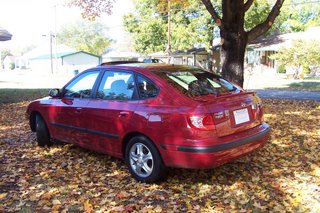 So--that explains the minimal effort to blog over the past couple/few weeks.
But, a couple things happened in the last couple days that jarred me out of my rut. Firstly, I was sitting on the front porch smoking my pipe in late afternoon and the light just changed. It became gold. I looked up and the setting sun was illuminating the aforementioned maple. our house faces east, so I was unaware of the setting sun until the tree started glowing. I grabbed the camera and took a photogram--

Another thing happened today. We took master Wesley to the ENT specialist and he diagnosed ANOTHER ear infection. He recommended tubes, and Wesley will be getting those next week. I didn't realize our poor boy will need to be put under to perform the surgery. I suddenly feel like a papa goose with one of his goslings being threatened. I know it will be best, but I'm nervous for him. I'm glad he's not old enough to worry. All this pales in comparison (doesn't it always) to a parishoner whose 2 day old granddaughter will be undergoing heart surgery in the next day or two to try and reroute her heart! She'll have another open heart surgery at 6 months and another after 2 years. I can't imagine being in that hospital room in Westwood holding my new baby boy and looking at the prospect of 3 open heart surgeries in the next two years. How do parents do it?????? Wesley's been strapping and healthy--I can't imagine the stress and angst and heartache that some parents feel for their newborns. What a cruel ordeal!
Through all this, I've been trying to come up with something to say about the widow's mite. I read something or other that said that the widow was able to give her all because she didn't have much in the first place. 2 copper coins wasn't going to do anything for her anyway. The rich gave a portion of their plenitude. Jesus pointed to her and said, "there's the Kingdom of God." Perhaps we are sometimes stripped bare before we are able to give our all to God. The four noble truths seem to echo in my mind associated with this story-- suffering is with us from birth: (dukkha--isn't that a great word for suffering?) The root of suffering is craving. The cessation of craving is the cessation of suffering. The path of this cessation of craving and suffering is the eightfold path. (right view, right intention, right speech, right action, right livelihood, right effort, right mindfulness, right concentration). the widow was actually rich because she expressed an absence of craving. The rich who gave more money gave out of their wealth--they weren't as impressive because they still clung to their wealth.
Well--that jumpstarted a few thoughts (not finished with sermon yet--I look forward to being able to weave in some Buddhism into the sermon) check on the church website for the finished product!
Pray for little Shelby! While you're at it, throw one in for Wes too--and his poor, worried pop!

 So--that explains the minimal effort to blog over the past couple/few weeks.
 But, a couple things happened in the last couple days that jarred me out of my rut. Firstly, I was sitting on the front porch smoking my pipe in late afternoon and the light just changed. It became gold. I looked up and the setting sun was illuminating the aforementioned maple. our house faces east, so I was unaware of the setting sun until the tree started glowing. I grabbed the camera and took a photogram--

Another thing happened today. We took master Wesley to the ENT specialist and he diagnosed ANOTHER ear infection. He recommended tubes, and Wesley will be getting those next week. I didn't realize our poor boy will need to be put under to perform the surgery. I suddenly feel like a papa goose with one of his goslings being threatened. I know it will be best, but I'm nervous for him. I'm glad he's not old enough to worry. All this pales in comparison (doesn't it always) to a parishoner whose 2 day old granddaughter will be undergoing heart surgery in the next day or two to try and reroute her heart! She'll have another open heart surgery at 6 months and another after 2 years. I can't imagine being in that hospital room in Westwood holding my new baby boy and looking at the prospect of 3 open heart surgeries in the next two years. How do parents do it?????? Wesley's been strapping and healthy--I can't imagine the stress and angst and heartache that some parents feel for their newborns. What a cruel ordeal!
Through all this, I've been trying to come up with something to say about the widow's mite. I read something or other that said that the widow was able to give her all because she didn't have much in the first place. 2 copper coins wasn't going to do anything for her anyway. The rich gave a portion of their plenitude. Jesus pointed to her and said, "there's the Kingdom of God." Perhaps we are sometimes stripped bare before we are able to give our all to God. The four noble truths seem to echo in my mind associated with this story-- suffering is with us from birth: (dukkha--isn't that a great word for suffering?) The root of suffering is craving. The cessation of craving is the cessation of suffering. The path of this cessation of craving and suffering is the eightfold path. (right view, right intention, right speech, right action, right livelihood, right effort, right mindfulness, right concentration). the widow was actually rich because she expressed an absence of craving. The rich who gave more money gave out of their wealth--they weren't as impressive because they still clung to their wealth.
Well--that jumpstarted a few thoughts (not finished with sermon yet--I look forward to being able to weave in some Buddhism into the sermon) check on the church website for the finished product!
Pray for little Shelby! While you're at it, throw one in for Wes too--and his poor, worried pop!
Thursday, October 26, 2006

Wednesday, October 25, 2006
Monday, October 23, 2006
Little Cups
Two churches I have now pastored, and two churches who have significant numbers of people who are majorly skiddish about using a common cup to celebrate communion. This past month at charge conference our DS led communion. Because I wasn't sure what kind of turnout we would have, I simply elected to use my chalice to serve communion. We ended up having about 30 people--and that was great. As I served people the cup into which they would dip their bread, I noticed faces of apprehension and even disgust. Oh, how entrenched are we in our customs, especially around communion. It seems that the cultures I have served are perhaps concerned about the cleanliness of taking communion by intinction. Instead we use little cups.
What do little cups say about us as a culture of Christians? First of all, This Holy Mystery proclaims little cups to be the bane of eucharistic theology. Their use destroys the symbolism of the liturgy. "After the supper was over, Christ took the cup--no Christ took little plastic cups and gave one to each of his disciples, saying "Drink ye from each of thy little cups, throw them in the trash on the way out the door, and do this as often as you drink it--or once a month, whatever." I suppose it seems that I'm being a bit persnickity, but to me it is more powerful to offer a single cup. "One cup of blessing which we bless," the list goes on and on of all the references, hymns, prayers, etc. that aren't given visual representation becasue we want our own little cup.
Is the little cup indicitive of our radical individualism? When did they come into use, and why? Are they commonly used in other parts of the world?
"Are you willing to drink of my cup and share in my baptism?" says Jesus. "No thanks, I'll have my own little cup thank you," says the church.
What do little cups say about us as a culture of Christians? First of all, This Holy Mystery proclaims little cups to be the bane of eucharistic theology. Their use destroys the symbolism of the liturgy. "After the supper was over, Christ took the cup--no Christ took little plastic cups and gave one to each of his disciples, saying "Drink ye from each of thy little cups, throw them in the trash on the way out the door, and do this as often as you drink it--or once a month, whatever." I suppose it seems that I'm being a bit persnickity, but to me it is more powerful to offer a single cup. "One cup of blessing which we bless," the list goes on and on of all the references, hymns, prayers, etc. that aren't given visual representation becasue we want our own little cup.
Is the little cup indicitive of our radical individualism? When did they come into use, and why? Are they commonly used in other parts of the world?
"Are you willing to drink of my cup and share in my baptism?" says Jesus. "No thanks, I'll have my own little cup thank you," says the church.
Wednesday, October 11, 2006

Monday, October 09, 2006
Good program coming up
Moyers on America : “Is God Green?”
PBS Airdate: Wednesday, October 11 at 9 p.m. (check local listings). 60 minutes.
A new holy war is growing within the evangelical community, with stakes for the earth and American politics. For over a decade liberal Christians have made the environment a moral commitment. Now some conservative evangelicals as well are standing up for the earth as a Biblical imperative of stewardship. From a dynamic conservative church in Boise , Idaho to an evangelical activist group known as Christians for the Mountains in West Virginia , grassroots believers are speaking out. So are some conservative evangelical leaders at the national level who have called for action to stop global warming. But they are being met head-on with opposition from religious right political figures like Jerry Falwell and James Dobson, who are pillars of the right-wing coalition that adamantly supports the Bush administration in downplaying the threat of global warming. The political stakes are high: three out of every four self-identified white evangelical voters cast their ballots for George W. Bush in 2004. The program explores how a serious split among conservative evangelicals over the environment and global warming could reshape American politics.
PBS Airdate: Wednesday, October 11 at 9 p.m. (check local listings). 60 minutes.
A new holy war is growing within the evangelical community, with stakes for the earth and American politics. For over a decade liberal Christians have made the environment a moral commitment. Now some conservative evangelicals as well are standing up for the earth as a Biblical imperative of stewardship. From a dynamic conservative church in Boise , Idaho to an evangelical activist group known as Christians for the Mountains in West Virginia , grassroots believers are speaking out. So are some conservative evangelical leaders at the national level who have called for action to stop global warming. But they are being met head-on with opposition from religious right political figures like Jerry Falwell and James Dobson, who are pillars of the right-wing coalition that adamantly supports the Bush administration in downplaying the threat of global warming. The political stakes are high: three out of every four self-identified white evangelical voters cast their ballots for George W. Bush in 2004. The program explores how a serious split among conservative evangelicals over the environment and global warming could reshape American politics.
Read the small print
I switched to Blogger Beta becasue "it was a lot easier, blah blah blah." The problem is that it took all the html code I had with it. Now I have to relearn. No time.
Wednesday, October 04, 2006

Subscribe to:
Posts (Atom)

 Posts
Posts


