Earlier this week, I submitted some posters to the digital communications office at University of Tulsa to display on the scrolling message boards that promote events all over campus. Just today, I noticed that they were displaying the one for tonight's Living Last Supper, featuring two of the disciples from DaVinci's masterpiece engaged in discussion, with the tagline "Everyone's Talking about the Living Last Supper." I had also given a poster with David Mach's crucifixion sculpture (called "Die Harder," yes, "Die Harder") displayed in some cathedrals around London with the tagline "Embrace This" written, quite brilliantly, if I do say so myself, in ransom note font. I noticed it wasn't scrolling too, but just figured they would be putting it up tomorrow. When I got back to my office, I noticed an email from one of the staff people in the student affairs office apologetically informing me that they had been running the Good Friday poster too, but a student called and was concerned that it was "too disturbing for display throughout campus," and asking if it would be possible to submit another image for use with the promotion.
I was elated. What a fitting response to the cross! I had just been speaking with a student leader at the Wesley foundation about the image over lunch (the International Student Ministries Lunch featured it on their announcement slideshow) and how I chose it because it is so gripping and different. The ubiquity of crucifixion portrayals somehow works to defeat the power of the image, in a way. We're not really shocked by it, we might not even take a second glance at it. But for some reason, perhaps because of the prickly coat hangers that protrude from the giant figure of Jesus, perhaps because of the utter agony on his face, this one is captivating. We don't just glance over it. It prompts an emotional response, and is therefore great art. Not that all those beautiful images of the crucifixion aren't great art, but Mach's piece makes a good case for themes continuing to be explored in modern conceptions. If we're no longer shocked by "conventional" crucifixions, then they have lost an integral aspect of their purpose. “The figure of Christ is in pain and anguish pierced by thousands of spears, that single body acting as a conduit for all the cares and the woes in the world” says the artist talking of the lowly, humble coat hangers which pierce the figure, acting like a “language or currency common to us all”. I've read that it is so captivating that it is quite a sensation in the UK, and is drawing people into churches to observe and just sit in its grip, and judging by the expanded works on the same theme, I'd say the Church of England has decided it is an effective mode of communication. I'm glad the Church of England is willing to push boundaries and display such a "challenging" work.
And yes, I sent in another poster that I was using to promote Good Friday as well. I never thought I'd see the day when a Salvador Dali painting was the "more palatable" option! Now the familiar Christ of St. John of the Cross looms over a landscape with the tagline, "Larger Than Life," inviting people to the Service of Darkness tomorrow night.
Ever since I was exposed to Japanese woodblock paintings, most memorably at LACMA's wonderful Asian Art Wing, I've loved Hokusai. I remember one time when I was watching a movie called "Pi" (I can't figure out how to make that mathematical symbol), I was captivated by a an image in the movie of a seashell, which illustrated the "Golden Mean," and when I looked up at the picture on my wall of "The Great Wave," it struck me that Hokusai's wave also seems to be in the same arc illustrated by that mysterious number. So, in the peom below, I attempt to capture that connection by using the Fibonacci sequence (0,1,1,2,3,5,8,13) to guide the syllables and rhythm of the meter. With this tactic employed, it also became a "shape poem."
“Hokusai’s Great Wave”
()
Crash
Crash
The Foam
Circles Us.
The deep deathly blue
Looms like an enormous monster
Flaying out cat-like claws and ready to pounce on us.
There's nothing really "web 2.0" about Morris, OK. A handful of my church-members have blogs or twitter accounts, and a larger group have facebook pages, but quite a few more have dial up connections or nothing and don't really know how to use the computer. (They sure could school me on repairing a light socket or running a tractor or birthing a cow though.) But, since this is my context, I sometimes hesitate to unleash something like the following at church, though I really want to. So, instead--you are the web 2.0 church I preach to, mkay?
Today's sermon comes with a hat tip to Darren Solomon of "Science for Girls" who created the "In Bflat" collaborative music project, which I heard about today on NPR in the car and pulled over to write a note to myself to check it out when I got home. (Okay, I didn't pull over, I just drove with my knee while fishing around the car for a pen--hey the roads are pretty straight and trafficless here in rural OK). The link to the In Bflat thing is here: http://inbflat.net/
The idea I had today (Saturday, which is the day before Sunday) was to set up the webpage in the church service and then have the congregation call out different instruments to start, etc. I just know something would probably go wrong though: probably get a hang up with my wifi or something, and I imagine half the congregation would kinda not know what the hell was going on anyway.
But if I were to pull out this cool thing (and I still may next week), what I would like to relate it to is the power of a common theme (such as the season of Lent or the key of Bflat) to make sense of or harmonize various sounds or experiences. So, abiding by a season of faith is essentially a collaborative exercise. People all over the world are reflecting on temptation, struggle, repentance, mortality, wilderness, and preparing to receive the mind blowing newness of resurrection, grace, and transcendence.
About 12 years ago, I had a vision of how we relate to God/the Ground of All Being in a sort of visual metaphor that encapsulated many different approaches. Basically it posited that God was the Ocean, and the way that we relate to that Ocean typifies many different ways of relating (or not) to God.
Some go out into the water and snorkel or play water games with others. They are in the Ocean, with their feet in the mushy sand, and enjoying the sway and rocking of the waves, but their attention is also on the company around them. I would interpret these as those devotees who are involved in a relationship with God, but also with the “community of faith.”
Some go out into the water and kick up their feet and float. They let the power and volume of the Ocean support their weight, and the water covers their ears. They stare up at the sky and float on the waves until they truly feel at one with the Ocean. These, in my interpretation of the vision, are the mystics who experience transcendence.
Some go out into the water, and either enjoy the frolicking with others or kick up their heels for a few moments, and then feel an overwhelming urge to go back out of the water and try to get others to join them. I would call these “evangelists” or “bodhisattvas.”
Some go out into the water to swim against the incoming tide. They test their own bodies against the power of the current. These are the religious athletes or ascetics.
Some have surfboards, and ride the waves of the ocean and interpret its motion in artistic jumps and speeding crescendos. This is how I see artists such as Bach or Dali or Hokusai or Bob Marley.
Of course, on every beach, you have some who just don’t go in the water.
Some walk along the shoreline for miles and miles, content enough to walk along the wet sand in their bare feet and roll up their pants so that the occasional wave can wash their soles of the little granules stuck to their feet. I would call these the religious dabblers who wander the great expanse of the shoreline, but never find anything compelling enough to take off their clothes and dive in.
Some sit on the beach (in their favorite spot) and admire the Ocean without ever going in: I would call these the people who like the idea of God, maybe they attend religious services, but have never had an experience of the Water. They’ve never really “felt” God.
Some feel the need to watch after others' safety in the water. They are the self-appointed “lifeguards” of the Ocean.
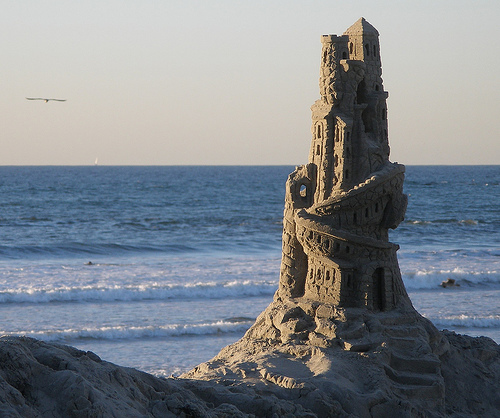
Some take the wet sand (earth infused with the Ocean) and build intricate castles, large and small. Some invite others to come and play in their sandcastles, some guard their sandcastles very jealously—worried someone is going to come around with the intention of destruction. Perhaps they may run out and jump into the waves every now and then to cool off, but their attention is primarily on the sandcastles. I would say these are the architects and attendants of religious structures. Primarily concerned with the construction and preservation of structures infused with the Ocean—but not the Ocean itself. (And what is it that Jimi said about sandcastles? J)
Some are so fascinated with the intricate life within the coastline and beach that they turn their back to the Ocean and have no interest in it. Some are so involved in the deep mysteries of each granule of sand that they have dug deep trenches down into it, ready to discover more and more. They have dug down so deep, in fact, that they no longer see the Ocean at all—and some of them say to each other, “Ocean—you believe in that hullabaloo?” But the deeper they dig, the closer they get to the water that has seeped under the sand. And they may believe they have found something new, but it will of course be the Ocean.
And then there are all those who ignore the ocean entirely. They are sitting in traffic on the 405, because there have so many important things to do.
Where do you see yourself in this metaphor? Or is there another way that better describes your understanding of God?
I don't really stop being an Arkansas Razorbacks football fan during the offseason. I feel right now like I probably should feel during Advent anticipating Christmas, being a minister and all. A whole season of exciting games is only two weeks away. I enjoy the chatter of other excited football fans on a message board, which has become a good stand in for actually being in state and having the random Razorbacks discussion with other Arkansans.
A friend of Lara's was recently baffled by how either of us could consider ourselves fans of the Razorbacks since neither of us went to U of A. He suggested that we should instead be UTulsa fans or UCLA fans since Lara's PhD is involved in those two institutions since our undergrad didn't have a football team, but some actual connection must be made to the U of A if you have actually attended secondary education and want to cheer for the Hogs. (his logic holds that high school graduates who never go to college are "allowed" to be fans of the state institution of their home.) Perhaps his argument is logical, but logic has no basis in college fan-dom.
I remember when we first moved to Oklahoma tuning into to Razorbacks connected us to home as the summer days grew cooler. I remember staying up until almost 1am watching the Ole Miss game go into 7 overtimes and shouting with a friend on the phone when we finally won it. I remember two seasons later watching the Hogs take on the Kentucky Wildcats and taking that game into 7 overtimes as well. (Arkansas owns the title to playing the three longest NCAA football games, including a 2002 6 overtime loss to Tenn. to go with the two 7 overtime victories.
I remember I used to have to go to Hooters at 9am in the morning in Santa Monica to catch the 11am game-time in Arkansas. (I guess I hadn't discovered pay-per view yet) These two internet gamblers would be the only other two guys in the place, and they used to marvel at the way the Hooters girls would flirt with me. I showed them the ring on my finger, and said, "They see this, no doubt. I'd think they see me and think, 'safe and flirtation starved=good tip.'"
Razorback games are also deeply embedded in my personal history. They are part of my identity. I may not have gone to the University (I fell in love with Hendrix College when I attended Governor's school there and met a great new group of people planning to attend there), but I did grow up in Fayetteville and spent many fall afternoons as a 8, 9 and 10 year old trudging up and down the stairs of the bleachers in Razorback stadium with a tray of Cokes strapped around the back of my cub scout kerchief clad neck raising money for scout camp on the Buffalo River. I'm just old enough to have those last days of the old Southwest Conference embedded in my mind. I remember I used to get in a rhythm leaning a little bit backwards walking down steps that I couldn't see in front of me for the big metal tray of Cokes. People would stop me, and I'd pass a commemorative cup their way, and they'd send a couple bucks down the row for me to put in my little canvas pouch. I enjoyed walking down the steps instead of up them even thought the prospect of falling forward was a bit scarier, because then I could watch the game as I delivered refreshment to the thirsty masses.
When we lived in Los Angeles, I remember watching some games on the couch with a pregnant Lara, and Wesley would jump around in Lara's womb when he'd hear us hooting and hollering about a big play.
We went to San Francisco one year for Thanksgiving, and stayed in this ultra-mod appointed (but cheap b/c it was a like a Euro-hotel with one or two bathrooms on a floor. We went to a diner in downtown SanFran to get a turkey meal to go, and we watched the Miracle on Markham" (that year we won in dramatic fashion) while reclining on our bed watching a retro, egg shaped television perched on a little table that jutted out of the foot of the bed. I remember our voices echoing out on the rain washed street as we watched Matt Jones (a run-first option qb (now a receiver in the NFL) make two unusual and unlikely completions to win the game for us in the last seconds of the game.
When I was in Oxford ('99), I listened to the radio broadcast of the Tennessee game where we avenged the previous year's heartbreaking loss on yahoo radio. I remember sitting there wondering what kinds of marvelous powers of communication the internet was going to afford me in my life if I could sit in my roomate's room upstairs on Marlborough road in Oxford listening to Paul Eels call the game through a regional radio broadcast coming through the internet.
Being a Razorback fan is just part of being an Arkansan, I'd say--and you could logically say I'm no longer an Arkansan, since I've spent the past 4 years in Oklahoma, and lived in Oklahoma for another 2 years before that. So, logically speaking, I'm 3/32nds Californian, 1/8th Missourian, 1/7th Oklahoman,and 22/32nds Arkansan.
Most of these stories share a common thread--being a fan connected me to my home state as I have been living elsewhere. Fan-dom is a kind of resonating with home.
So, there's my apologia for being a Hog Fan. Woooo Pig Sooie
Well, if that title doesn't get some clicks from my RSS feeders after 2 months of incommunicado from little ole me, I don't know what will. So, I'll break the ice (after 2 months away, I do feel kind of frozen about the idea of posting anything short of a manifesto) with something spiky. Well, to make it easier on myself, it will be more like an annotated link of something spiky. I've really been enjoying the tv channel Current. (esp. Viral Video Film School.) I just watched this little news clip about a new* sex-art-porn? magazine called H-Bomb at Harvard, and it got my attention because 1)I wrote a book chapter (sp ;) on some of the issues brought up in the clip and 2)BC they mention that the magazine is beginning to franchise out and they mention Boston U, where my sister is hoping to enroll in the MFA program in the winter, and where several of my friends have gone/are going to seminary.
So, a few quick notes, then I'll give you the video. First, I like Current's strive for some balance in reporting. They interview one of the editors, a professor who teaches the evolution of sexuality, and a couple who started an abstinence support group on campus. For what it's worth, I think the pro-abstinence couple give perhaps the most cool-headed and articulate reasoning for their perspective that I've ever heard. You can tell they've had to explain their position to other Harvard students, and that takes a little more rationality, I would say at the risk of sounding snobbish, than the average Campus Crusader pleading for virginity for purity's sake. I think the "hook up culture" really came on the strongest after my time in college, but from what I understand about it (I remember seeing an interview with a bunch of SMU students on Religion and Ethics Newsweekly one time), there is a real absence of a sense of need for commitment in sexual relationships in college environments these days. (Wow, convoluted sentence, or was it even a sentence? Oh well, I'm rusty.) Secondly, I'm interested in the magazine editor's accusation that the general media has a very simplistic notion of what constitutes pornography versus what qualifies as art (she obviously categorizes her magazine as art,) but she never quite clears up for the viewer what makes the general media so obtuse in it's view. Do they not understand that a filtered photograph or a grainy photograph is art and a bare bones video is not? If the general media is missing the distinction, then what is the distinction? Is it because it is made by and for Harvard students, as opposed to Arkansas Tech students? Does the culture surrounding the medium give it it's identity, or is there a "thing in itself" about the presentation of sexuality that renders it either pornography or art?
By the way, as I was writing this, I googled the H-Bomb and found out that I must have been watching a re-run of Current. (A re-run of Current: hahaha) Because this article from the Crimson from 2007 shows that the Hbomb magazine went belly up after only two issues in 2005, and the group lost it's status as a student group, oh well. I'm late to the game, but then again, you probably know that based on the fact that you haven't gotten a post out of me in two months. I could give you the list of reasons, but I'll refrain.
One of my favorite profs from seminary (Philip Clayton) was instrumental in getting this conference together, which I didn't go to, but was interested in. I just watched my first lecture from the conference, and was impressed with Barry Taylor's lecture:
I've always thought that the intersections/battlegrounds between consumer culture and religious culture are worth my interest. In ways that have been more fully fleshed out by great minds like Wendell Berry, Jay McDaniel, John Cobb, and Jonny Baker (among others). But since I am interested in being condensed tonight, I'll just say I think it is one way that the church is in the midst of a new kind of empire in this day and age. This empire wants to colonize your mental space and enslave your mind as much as the Roman empire cared to colonize your homeland and enslave your body.
When the tension between consumerism and Christianity are expressed in art, I take note. I saw on Jonny's blog a link to the new "Mickey Christ" statue unveiled at a Beijing mall. It speaks quite well to the tension itself, and then the comments below the picture are also enlightening.
The statue reminded me of Banksy's "Christ with Shopping Bags." Also worth examining.
I recall using the Banksy thing for something one time, and a person in an older generation than my own was worried about promoting the image by using it. The person's concern evidenced a real difference between generations, I think. I believe my generation is much more intuitive about irony and less likely to be offended by it. I realize that is quite a blanket statement, and don't claim that is an airtight theory. It just seems that irony is a lot more utilized (especially in consumer culture/marketing.) in my generation and younger. Would you imagine Burger King so gleefully suggesting to the consumer that they are ripping off McDonalds in any other generation? Commercials used to be so earnest! They were the real thing! and now what we have is so smarmy and snorting. (But, I really do prefer the smarmy snorting kind of commercialism to the one that attempts to tap into the Zeitgeist of a generation and market that to itself......or, is that just what today's brand of consumerism is as well, young grasshopper?)
As you can see, my own mind is colonized. Commercial taglines like "Give me a break" or "Dr. Pepper, You make the world taste better" frequently echo out of my subconscious and out of my mouth with the gusto of the original jingle singer. As I link up those two references, I imagine that they will resound down into the canyons of your own subconscious too, dear reader. Woe is us! Being that this is our mental/spiritual landscape, who are we to deny the Spirit's bucking against the shitstem like an angry bull? That's what I see happening in those art pieces. Some people, get caught up in their own sense of indignation about images that confound them and fail to see the truth conveyed--not the Truth That Is, necessarily, but the truth we've made.I don't say that with any sense of "holier than thou" attitude--perhaps the generational thing is simply reflective of a my own genration/culture being more thoroughly warped by consumerism.. Whew, this was supposed to be a brief post....
We missed one pretty big tornado by about 12 miles tonight. For someone who lives in the heart of tornado alley, I've never gotten used to them. My sister has actually been in a couple of pretty bad ones, though I never have. Fortunately, we kept electricity throughout the storm tonight, so I could watch our trusty weather man give me assurance through the whole thing. Maybe you've heard of how much we love our weathermen in Oklahoma. "Just listen to Gary England, baby, he's gonna tell us when things are o.k!
. After the worst of it had passed (including a big funnel cloud that passed just to the north of Morris, turning the sky a weird color and revealing the cotton ball looking clouds that seemed to be hanging out of the gray sheet), everyone was out in the street looking at the sky. Some guy I didn't know waved at me as I walked back into the house. Morris was destroyed by a tornado in 1984, and it's for this reason that we don't have a pretty downtown with historic brick buildings and all that. I imagine folks see something like that pass us by, and it reminds them that we are a community. This has been the first big tornado event of the year here, most of them have sprung up to the east of us. Isn't it an El Nino year?
(Note: Happy Arbor Day! I wanted to post a little earlier in the day to remind you in case you plan on planting a tree on arbor day. I might get a chance to post something else later or on Sat, but here's an excerpt from a report I gave to the Fund For Theological Education, who gave me a grant when I started seminary. It's not every day I sing the praises of a pharmaceutical company, but Lilly really has provided me a lot of opportunities in my education as a minister, including what I've gained from the FTE.)
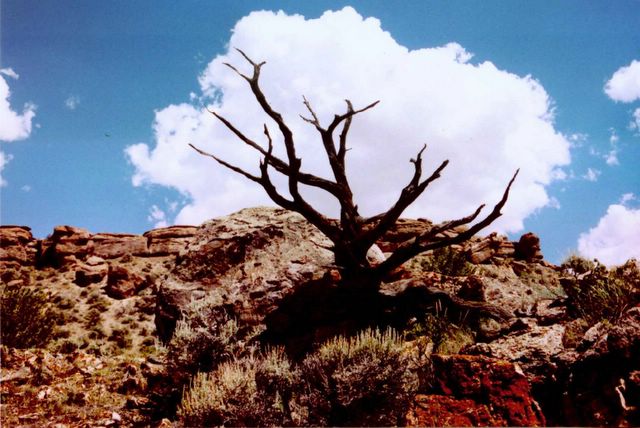
....In Wyoming, I had the opportunity to take time to connect with the outdoors. Here I attended a workshop with Belden Lane, author of The Solace of Fierce Landscapes, and Landscapes of the Sacred, Geography and Narrative in American Spirituality. At this workshop, the general theme of a landscape’s influence on our spiritual lives was explored. Because one of the participants was a geologist, we also considered the timeframe and history of a landscape as a spiritual journey in itself. In this glacial valley, sitting among petroglyphs that were expressions of mystical visions, I received a message from the Holy Spirit through the wind blowing through the trees. This is the prayer with which I responded:
Fill us, o wind of God—Great Spirit of Transformation
The trees taste your presence and shout their thanks and praise. In the whistling of their needles and limbs, they sway in a dance with you. They display openness to your guidance. Help us to be more like the trees in their wisdom. Blow into our heads and refresh our minds, o mighty wind of God. Stir the embers that reside in our hearts. Fill our lungs like you fill the lungs of these pines. As they give voice to your movement, we will also sing your praise. As the trees move with your breath, unite the fire in our hearts with the newness of our ideas to make manifest in our lives a reflection of you. Blow through us, Spirit. Make us your tongues in this world, as you did on Pentecost. Help us speak the same language with all creation so that we might have communion. Lord you have written your vision in the interdependence of all things in nature, but we have attempted to escape that beautiful purpose for the rickety designs of our own greed fear and ignorance. Lord, give us the voice of the tree.
...At SequoiaNational Park, my wife and I camped among the lodge pole pines that surround the “GiantForest” of Sequoias at 6500 feet. As we walked among these trees, which have a magnificence and gentleness that are unparalleled in creation, we learned several things about God’s intentions for creation. Though the Sequoias sometimes grow too tall and massive to be supported by their own roots in a shallow three feet of soil on top of solid granite, the trees interlock their roots to support each other. Though this fact does not make much sense to a scientific worldview of competition, it does show that God’s purpose for creation is for us to welcome our interdependence and not live outside the relationships that support us all. As I sat among the mighty Sequoias, I read the thoughts of John Muir.
Do behold the King in his glory, King Sequoia! Behold! Behold! seems all I can say. Some time ago I left all for Sequoia and have been and am at his feet; fasting and praying for light, for is he not the greatest light in the woods, in the world? Where are such columns of sunshine, tangible, accessible, terrestrialised? Well may I fast, not from bread, but from business, book-making, duty-going, and other trifles, and great is my reward already for the manly, treely sacrifice. What giant truths since coming to Sequioia gigantea, what magnificent clusters of Sequoiac becauses.
Note: between Wednesday, April 27 and Friday, April 30, which is arbor day, this blog will be devoted to trees. Why don't you celebrate by planting a tree? Please comment and tell me about your special trees. If you're so inspired by this post that you can't wait for tomorrow's post, you can look at my tags for trees and treehouses.)
I’ve noticed that Wesley’s Christmas tree (that blue spruce next to the East driveway of the church) has been putting out bright green new branches lately. That tree has been in the ground for four years now. Blue Spruce are known to be slow growers, and the tree has only grown a six inches a year or so. I’ve recently Julianna’s 2nd Christmas tree too. (We bought tabletop trees to plant for Christmas when the children were two—we found it easier to keep ornaments on the tree). Wesley’s tree’s growth is especially noticeable because it sits next to Julianna’s tree—which has not yet put out any new growth. I haven’t been able to find any information as to whether this is to be expected with a new tree that was just put in the ground in January, so if there are any horticulturists out there who have good advice, let me hear it because I’m worried about it!
Scriptures say that God expects and hopes for us to show new growth in our Spirits. Much is said in the Psalms and Prophets about fruitfulness and it is a major theme of Paul’s letters to the church. Paul encourages the believers to bear fruit in their spiritual lives. Just to make things clear, Paul spells out how that looks on a practical level. “But the fruit of the Spirit is love, joy, peace, patience, kindness, goodness, faithfulness, gentleness and self-control. Against such things there is no law.” (Gal 5: 22-23)
Jesus speaks of the urgency of us bearing fruit in prophetic action, recorded in Mark 11 and Matthew 21. Jesus walks up to a fig tree (which Mark says is “not in the fruit bearing season, but had leaves”) and finds that it has borne no figs. He curses the tree, and the disciples watch in amazement as the tree withers from the root. I’ve always felt sorry for that poor fig tree. It seems so out of character for Jesus to curse and hurt a living thing. I took this question to Brother Aidan, a hermit monk I had the opportunity to stay with for a week around 10 years ago. He spoke about the importance of bearing fruit when we have an encounter with Jesus. It’s not good enough just to just be in proximity to Jesus, we must respond to that presence. Whatever we are called by God to do, even yield fruit out of season or tell a mountain to throw itself into the sea, we must be bold enough do it.
But I’m not the only one who has a soft spot for the fig tree. This is one of those interesting stories that is contained in Mark (which Matthew and Luke utilized to compose their own Gospels) that Matthew adapted, but Luke left out entirely. Actually Luke doesn’t leave it out, he simply rewrites it as a parable. In Luke 13: 1-9, Jesus tells the story of a man who has a fig tree planted in his vineyard, and seeks fruit from it, but finds none for three years, and then tells his servant to cut it down. The servant then pleads with the landowner to spare the tree for another year, in which he will tend it carefully, putting manure at its roots, and then see if it will finally produce fruit. Tradition says that Luke was a physician. Perhaps he just couldn’t see Jesus cursing a tree because of his own interest in helping people recover from injury and disease. Instead, he recounts Jesus being the servant. He’s here to tend to the tree and stave off destruction. Still, urgency is implied in Luke’s story as well.
I like Luke’s story much better than Matthew and Mark. I can see Aidan’s point about the urgency and necessity of complying with God’s call on us, but I think Luke’s picture is more in harmony with Jesus as Master Physician and Finder of Lost Sheep. I think God looks at us with the same sympathy and hope that I look at my kids’ two Christmas trees. I see the one putting out new lush green branches, and I see the other looking more brown and brittle by comparison. Instead of being angry with brittle tree, I wonder what more I can do to help it become vibrant and growing.
Note: between Wednesday, April 27 and Friday, April 30, which is arbor day, this blog will be devoted to trees. Why don't you celebrate by planting a tree? Please comment and tell me about your special trees. If you're so inspired by this post that you can't wait for tomorrow's post, you can look at my tags for trees and treehouses.)
In the 30 foot willow across the street, my neighbors and I once broke out a bunch of branches to build a little platform for a neighborhood cat. I was about 8 or 9. We didn't ask the cat if he wanted a 20 foot high platform in the tree, and he didn't seem to like it that much. I remembering him scampering down after we flopped him out into the sunlight, never to return. We didn't ask our neighbor who owned the tree either, and he called the police to pay us a visit. I vividly remember the blue uniformed police officer coming to 3115 Cherokee drive. He asked for me, and my stomach dropped. I lied and said I didn't do it. I remember the feeling of my throat swelling as I told the lie. It didn't feel that easy, so I imagine he could probably see the truth on my face.
Years later, I still felt horrible to lying to the policeman. I sent a confession to the police department, and they wrote a letter back to me which commended me on the bravery of telling the truth. (I had conveniently moved out of their jurisdiction by then.) I think I still have the letter in a chest at home.
(Note: From now till Friday, which is arbor day, this blog will be devoted to trees. Why don't you celebrate by planting a tree? Please comment and tell me about your special trees. If you're so inspired by this post that you can't wait for tomorrow's post, you can look at my tags for trees and treehouses.)
I used to love climbing trees. There were two maple trees next to my house in Fayetteville that I used to climb, and I remember liking how the bark was smooth against my palms and shorts clad knees, rather than grating and rough, like an oak or pecan or sweetgum. That maple was the tree I learned to climb in. It was small enough that I could climb to the top of it, and big enough to give a thrill. I used to sit in one branch that hung down like a little bench in the air, and my Kangaroos would dangle before I'd jump six feet to the ground.
There was a willow tree across the street, and I can't think of a better tree to climb in and sit under. There were two at the pond I used to fish as a kid. One had a big rock underneath the overhanging branches. It used to seem like an Arabian tent with a big rock altar to our God of the outdoors. It made good shelter when we used to shoot our b-b guns at each other from across the pond. If the hanging branches didn't deflect the b-b, the big sitting rock would.
At my recent college reunion, by friend Dawn was raving about my blog, and I was thinking, "Yeah, and I haven't posted on it in about a month. If you're a loyal reader, and this has caused you any grief or distress, I apologize. We've been taking advantage of some fabulous spring days to dig a garden. A lot of our churchpeople have taken that act as a communication that we are not going to be moving this year. As far as I know, they are correct.. I'm planning on harvesting what I'm planting. Perhaps it's being in the earth so much, or perhaps it's our recent acquisition of the ReNew VBS and how I've been impressed with it, or maybe it's just the beautiful weather we've had here in what we call "Green Country," but I've been "keyed in" to the natural world lately.
Last week I wrote my sermon from the front porch, listening to all the birds sing in our sweetgum trees, (because we now have wireless!!!) and I think my "attentive participation" in the Spring is making a difference in my spirit. The robins that hop around in our yard looking for bugs came right up to my feet, unafraid. There is something profound about not causing fear in a wild animal.
I think the way we are shaped by our surroundings is fascinating. I'll never forget the time I got to spend at a workshop at Ring Lake Ranch with Belden Lane on that topic. He wrote a book called "The Solace of Fierce Landscapes" that really resonated with me. I've always enjoyed mentally fishing on the stream that is formed by the merging of ecology and theology. I've had great opportunities to plumb those depths. (thank you, Lilly pharmaceuticals)
One thing that the winter does for me is give me enough silence and stillness, with only the constant sound of the wind, to re-acquaint myself with the wildlife and plant-life that comes springing back around. When I lived in Los Angeles and would come back to Arkansas in the summer, it would baffle me how green everything outdoors was. So, in the same way, winter annually lulls our eyes and ears to sleep only to have them awakened again, refreshed and renewed.
So, in the spirit of Belden Lane, beautiful weather, birds chiriping, and Earth Day, I introduce you to my surroundings:
First are our two big Sweetgums. They give us a workout in the fall and winter with all the balls they drop, but they give nice cool shade in the summer, and I like to hang my dartboard on the closest one there. They rise to about 40 feet or more.
Lao-Tzu enjoys the empty lot to the south of our house. There's always something to prowl around for out there, and that makes a cat feel worthwhile, I suppose. (Although she's gotten stuck in Lloyd's skunk traps on occasion)
There are four pecan trees in the big lot to the south of our house. We enjoy finding pecans and munching on the ones that don't have wormholes. I can occasionally practice with my pitching wedge in the lot when it is mowed. (It is not right now)
Even further south is a cow pasture with some Black Angus cattle owned by a church member. One time we got 1/4 of a cow from him. This made me feel sustainability superior to everyone else. That is, until we left the freezer unplugged for a few days, and had to throw a good bit of it out. (Palm to forehead at that memory)
Looks like our little birdhouse in the maple tree in the front has an occupant. There are also a pair of huge barn owls that make their home in the top of that tree.
(I have a picture, but I can't find it.) This is the prettiest maple tree in town in the fall. It turns a brilliant golden color. (See!)
Last but not least is our fledgling garden that has been the source of much dirt in my fingernails over the past week or so. I hope it isn't too late to plant lettuce, b/c we have some of that, peppers, onions, tomatoes, strawberries, squash, and zucchini. I'm hoping the best for our garden, and I think we'll have plenty to share with friends. As Wendell Berry says, "One of the most important resources that a garden makes available for use, is the gardener's own body. A garden gives the body the dignity of working in its own support. It is a way of rejoining the human race."
Soon I'll be putting up some lattice work on our porch to give some more shade and privacy on the west. Then we'll be maxing AND relaxing.
I hope you've enjoyed your little tour of my yard. It's not glamorous, but it's beautiful in a humble way, I think. As Wendell Berry also says,"I see that the life of this place is always emerging beyond expectation or prediction or typicality, that it is unique, given to the world minute by minute, only once, never to be repeated. And this is when I see that this life is a miracle, absolutely worth having, absolutely worth saving. We are alive within mystery, by miracle."
(Boy, the new formatting thing really didn't work on those photos--any pointers blogger geeks?)
“Why do you look for the living among the dead?” (Luke 24:5)
These words, spoken by an angel at the empty tomb on Easter morning, haunt us—don’t they? They are words of hope but also of chastisement. We are people of the empty cross—we claim to celebrate the Resurrection every Sunday—and yet so often, we look for the living and breathing Christ only in the pages of record of a history that is dead and gone. We look for the living among the dead when we try to trap Jesus in the pages of the Bible only, and we fail to see him in the everyday world that we inhabit. As Jesus himself said, God is a God of the living, not the dead. That isn’t to say we should have no appreciation for the story of what happened. On the contrary, we gather together in the first week of April on Thursday and on Friday nights to remember that story that so often moves us to tears.
On Thursday we hear about the Last Supper that Jesus shared with his disciples. It was a celebration of the Passover meal, that yearly ritual in which all Jews remembered together with friends and family the powerful events of their own history, in which God brought them out of slavery in Egypt and carried them into the Promised Land. God had commanded his people to remember this event by participating in a meal each year. God knows us so well because God created us. And isn’t it true that sometimes a smell or a taste can cue a memory in our minds so vividly? Remembering is re-membering the past and how it continues to shape us.
On Friday, we hear the story of Jesus’ passion in the Tenebre service. “Tenebre” means darkness, and as the story unfolds and candles on the bare altar are extinguished, we’ll experience together perhaps a small taste of the darkness that must have been experienced that day by Jesus and his followers. That darkness is important. Darkness is integral to a deep and vibrant spirituality. St. John of the Cross was a 16th century Spanish priest who wrote about a “dark night of the soul” when describing the spiritual journey toward God. It is our fate to suffer and to grieve and to not comprehend the depth and breadth of the Truth and Love which envelops us. Fortunately, it doesn’t have to be that we suffer and grieve on our own or remain ignorant forever. So on Good Friday we gather in the darkness together. We huddle beneath the cross and hear the last words a loving savior gave his faithful followers.
On Easter Sunday, the Good News breaks open like that jar of nard that Mary used to anoint Jesus’ feet for burial. The Good News “fills the whole” place, as we hear of the surprised wonder of the disciples. But, as the angel said, we do not look for the living among the dead. The miracle of the resurrection, for us, is not only that Christ conquers death and returns to his disciples in a living and breathing body. It is the miracle that continues 50 days later, at Pentecost, when Jesus imparts his Spirit on the group that is gathered in his name and changes them into a living, collective, body. So, when we only seek Jesus in the pages of a story, however rich and beautiful and life-giving that story is—if our gaze is only directed toward the scriptures to try and find the meaning and power of a Living and Loving God, we are looking for the living among the dead. When we enact those scriptures, when we respond to them by living lives that are inspired (literally “breathed into”) by them, they become the “Living Word” that we so often call the Bible. Those words tell us to look around for God—look in our daily lives. Look especially at the poor and mourning. Pay close attention to those who are oppressed or maligned. It is easy to be inspired by the beauty of creation—and I can attest to the power of finding God’s presence in a magnificent sunset or in a grand mountain vista. But Jesus reminds us to not forget about the underbelly of creation too. Do we see God’s presence in the people the world says are repulsive? Jesus says, “I am there.” It is when we open our eyes to this truth that we seek the living among the living.
I wonder what it must be like
to be a priest
who places the sacrament
directly in the mouths of his people,
and sees them
as filmy eyed hatchlings,
peeping and desperately seeking
nourishment
with mouths wide open.
If anything were to ever make me feel transparent,
I think that would be it.
I heard what you said about social justice being a covert word used by secret communists and nazis in the church to advance the common agenda of those groups. I am disturbed and alarmed. My own church uses that secret code word on their church website, which is umc.org. I feel even more threatened because I began to notice lots of "Little Red Books" around the church. I have heard that this is a famous communist book so I began to grow even more enraged and appalled when I noticed that it said things like "All the believers were together and had everything in common. Selling their possessions and goods, they gave to anyone as he had need." and "When you give a dinner or a banquet, do not invite your friends or your brothers or your kinsmen or rich neighbors, lest they also invite you in return, and you be repaid. But when you give a feast, invite the poor, the maimed, the lame, the blind, and you will be blessed, because they cannot repay you." These are only a couple of lines from that wretched commie tract, and it's chock full of stuff like that. I feel so threatened and alarmed and disturbed and appalled and enraged that my head is spinning. Please give me some orientation with your words of determination and resolve and purpose! You told me I needed to run as far from my church as I can, but where can I find a church without those Little Red Books in them? I'm beginning to notice that they are everywhere, even in motel rooms! They even put little pocket sized copies of them in the children's Sunday School classrooms to infect their precious little innocent minds.
I've spent the past few days putting together this service for our church here in Morris. I'm excited, but also a little daunted about it. I'd say about half of our congregation has never heard anything by U2. (Mostly George Strait fans around here--and some family members of Merle Haggard) We're going to be doing a lot of sitting and listening to recorded music, so I'm trying to think of ideas to get the congregation active or involved in some way. I reeeeeealllly do not foresee any of my congregation getting up and clapping their hands and singing along and all that that may happen at other U2charists. But, the folks are used to me brining in a song from time to time to hear and reflect or perhaps write something while they listen, etc. If you have ideas, please share. I'm rigging up a screen so that we can see some of the videos or other images/slideshows I may put together over the next few days, so there's a whole other layer of things to be nervous about. I try to come right out of the gates with some of the most overtly religious songs by U2 to buy the some credibility with those who aren't familiar. I wrote a confession where I drew from a few U2 songs (Acrobat, A Sort of Homecoming, One, Love Rescue Me), but I'm also still considering just having Love Rescue Me as the song of Confession-It has great lyrics and was cowritten with Bob Dylan-put in your vote! Feel free to use or adapt for your own purposes. I'm really excited because one of the youth is going to play Yahweh on guitar for the service. There's a couple neat videos on youtube for that song too, so I may use them in some way as well. For the service of Word, I'm probably going to use an interactive reading that combines a few stories from the Bible with "I still Haven't Found What I'm Looking For" that I found at Bob Carlton's church. http://thecorner.typepad.com/bc/2006/02/u2charist_form_.html Thanks to them in advance. I also got the opening prayer from them. For the Children's sermon, I plan to talk with them about music and how it moves us, and then teach the kids to sing the old Bible School song, "this is the day that the Lord has made" which we will mash up with the refrain from Beautiful Day, "It's a beautiful day, don't let it slip away." Oh, by the way, I noticed I have nothing from the 90s in the service. Thought about using "One," my favorite song, but I had used that in a worship service recently, so they were already exposed to it. I'd rather give them new stuff. I'll probably wind up taking a couple/few songs out, I'd like to cut it closer to an hour to an hour and ten, but I thought I'd put the first draft up here for your use and pleasure, in case you're one of those hour and a half type churches. In Morris, OK, we have pot roasts in the oven.
First United Methodist Church www.morrisokumc.blogspot.com
U2charist: I will Sing a New Song
In this service of worship, we will be drawing from the music and lyrics of the band U2 to express our praise and thanksgiving, confession, and yearning for connection with God. The band has been making music on a world stage for 30 years. Each time they tour in concert, they draw millions of people, where they offer a sensory rich spectacle that attempts to focus fans toward goals in humanitarian causes developed by the United Nations. They offer prayers and even play Psalms and recite other Scripture when they play. They are a “secular band” that unabashedly proclaims their faith, and what it compels them to do in the world. Approach this service with the prayer that whether you are a longtime fan of U2, or have never really listened to them, God will open something new inside you.
Song of Praise: Magnificent (from No Line on the Horizon, 2009)
Magnificent
I was born
I was born to be with you
In this space and time
After that and ever after I haven't had a clue
Only to break rhyme
This foolishness can leave a heart black and blue
Only love, only love can leave such a mark
But only love, only love can heal such a scar
I was born
I was born to sing for you
I didn’t have a choice but to lift you up
And sing whatever song you wanted me to
I give you back my voice
From the womb my first cry, it was a joyful noise ...
Only love, only love can leave such a mark
But only love, only love can heal such a scar
Justified till we die, you and I will magnify
The Magnificent
Magnificent
Only love, only love can leave such a mark
But only love, only love unites our hearts
Justified till we die, you and I will magnify
Prayer: Liturgist
We gather here in your presence, God,
In our need and bringing with us the needs of the world.
We come with our faith and with our doubts;
We come with our hopes and our hunger.
We come as we are, because you invite us to come.
You have promised never to turn us away.
Open us, God, to experience you here.
All Respond:Amen.
Prelude: Rejoice (from October, 1981)
Scripture Lesson: Psalm 40, read responsively with response, p. 774 Liturgist
Song of Response: 40 (from War, 1983)
Prayer of Confession:
Holy God,
We confess at times of saying “Lord, Lord,” and then closing our hearts to others.
I must be an acrobat, to talk like this, and act like that.
We confess a numbness toward your presence in the world around us.
Dislocated, suffocated The land grows weary of its own
We confess that we bear grudges and plot revenge against one another
We hurt each other, then we do it again.
Our hearts are broken, Lord, mend them and fill them with your Love and Forgiveness.
I'm here without a name in the palace of my shame. Love rescue me.
Song of Assurance: Grace (From All That You Can't Leave Behind, 2000) Prayers of Joys and Concern:
During the time of sharing our joys and concerns, after a name or circumstance has been shared, the pastor will repeat the name or circumstance. If it is a concern, we will pray together, “We carry each other.” If it is a joy, we will pray together, “Only Love can leave such a mark.” After the local joys and concerns are shared, we will hear the song “Sunday, Bloody Sunday” which elaborates on the theme of war and violence, which are our global concerns, and is a prayer of petition.
The Lord’s Prayer
Alleluia
Offertory: Love and Peace or Else (from How to Dismantle an Atomic Bomb, 2004)
Children’s Sermon: Pastor
Interactive Scripture Reading and Homily
I still haven’t Found What I’m Looking For (from The Joshua Tree, 1987)
Invitation to Communion: Yahweh (from How to Dismantle an Atomic Bomb, 2004) Atticus Dellinger
Great Thanksgiving and Communion: All are Welcome to receive.
(I'll probably just choose three of these
American Prayer (Live version recorded at a concert in South Africa with Beyonce Knowles at a benefit concert for Nelson Mandela in 2002) Mercy (unreleased)
City of Blinding Lights, (From How to Dismantle an Atomic Bomb)
Where the Streets Have No Name (from The Joshua Tree, 1987)
 Earlier this week, I submitted some posters to the digital communications office at University of Tulsa to display on the scrolling message boards that promote events all over campus. Just today, I noticed that they were displaying the one for tonight's Living Last Supper, featuring two of the disciples from DaVinci's masterpiece engaged in discussion, with the tagline "Everyone's Talking about the Living Last Supper." I had also given a poster with David Mach's crucifixion sculpture (called "Die Harder," yes, "Die Harder") displayed in some cathedrals around London with the tagline "Embrace This" written, quite brilliantly, if I do say so myself, in ransom note font. I noticed it wasn't scrolling too, but just figured they would be putting it up tomorrow. When I got back to my office, I noticed an email from one of the staff people in the student affairs office apologetically informing me that they had been running the Good Friday poster too, but a student called and was concerned that it was "too disturbing for display throughout campus," and asking if it would be possible to submit another image for use with the promotion.
 I'd say the Church of England has decided it is an effective mode of communication. I'm glad the Church of England is willing to push boundaries and display such a "challenging" work.




 Posts
Posts


